
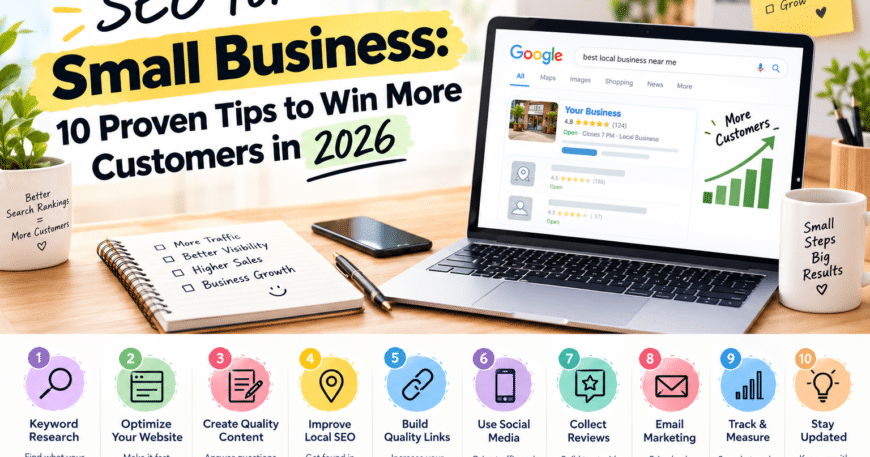
SEO for small business is one of the most cost-effective ways to win new customers without paying for every single click. When someone near you searches for a service you offer, showing up on the first page of Google can mean a steady stream of calls, bookings and sales, month after month.
The good news is that you do not need a huge budget or a technical team to get started. In this guide, our SEO team at NovaXperts shares 10 proven, practical tips that help small businesses rank higher, attract the right visitors and turn them into loyal customers in 2026.
Table of Contents
What Is SEO for Small Business?
Search engine optimization (SEO) is the process of improving your website and online presence so search engines like Google show your business to people who are looking for what you sell. SEO for small business focuses on the searches that matter most to a smaller company: local searches, service searches and high-intent questions from people who are ready to buy.
Unlike paid ads, SEO keeps working after you stop spending. A page that ranks well today can keep bringing visitors for years. That is why SEO is often called a long-term investment rather than an expense.
Why SEO for Small Business Matters in 2026
Customers now research almost every purchase online before they call, visit or buy. According to BrightLocal’s local SEO research, around 97% of consumers read reviews for local businesses, and more than half start their local searches on Google.
For a small business, this creates a real opportunity. You do not have to outspend big brands. You only need to be the most helpful, trustworthy and visible option for the people in your area or your niche. Done right, SEO for small business helps you:
- Get found by customers who are already searching for your services
- Reduce your dependence on paid ads and social media algorithms
- Build trust through reviews, helpful content and a professional website
- Compete with larger companies on the searches that matter most
10 Proven SEO for Small Business Tips
These are the same steps we follow when we start working with a new small business client. Work through them in order and you will build a strong foundation that keeps paying off.
1. Know Exactly What Your Customers Search For
Every successful SEO for small business plan starts with keyword research. Think like your customer. A homeowner does not search for “residential plumbing solutions”. They search for “emergency plumber near me” or “fix leaking tap cost”.
Make a list of your services, then write down the words people use to describe their problems. Free tools such as Google’s search suggestions, the “People also ask” box and Google Search Console show you real phrases. Focus on specific, high-intent keywords with a clear buying need instead of broad terms that every big brand is chasing.
2. Claim and Optimize Your Google Business Profile
Your Google Business Profile is often the first thing customers see, even before your website. It powers your listing in Google Maps and the local results box. To get the most from it:
- Choose the most accurate primary category for your business
- Add your services, opening hours, service area and a clear description
- Upload real photos of your work, team and location
- Post updates and offers regularly to keep the profile active
A complete, active profile tells Google your business is real and relevant, which is a big win for local SEO for small business owners.
3. Build One Strong Page for Every Service
Many small business websites list all their services on a single page. That makes it hard for Google to understand what you offer. Instead, create a dedicated page for each main service and each key location you serve.
Each page should explain the service clearly, answer common questions, show proof such as reviews or project photos, and end with a simple call to action. One focused page per topic gives you far more chances to rank.
4. Optimize Titles, Meta Descriptions and Headings
Your page title and meta description are your advertisement in the search results. A clear, benefit-focused title with your main keyword near the start can lift both rankings and clicks.
- Title: keep it around 50 to 60 characters and include your main keyword and location
- Meta description: write one or two persuasive sentences with a clear benefit
- Headings: use one H1 per page and organize sections with H2 and H3 headings
- Images: add descriptive alt text so search engines and screen readers understand them
On WordPress, a plugin such as Rank Math makes these on-page basics easy to manage for every page. If you are still choosing a platform, our guide on WordPress vs Shopify explains which one gives you more SEO control.
5. Make Your Website Fast
Speed matters for both rankings and sales. Visitors leave slow websites, and Google measures real-world experience through its Core Web Vitals. According to Google’s web.dev guidance, a good experience means:
- Largest Contentful Paint (LCP): under 2.5 seconds
- Interaction to Next Paint (INP): under 200 milliseconds
- Cumulative Layout Shift (CLS): under 0.1
Quick wins include compressing images, using modern formats like WebP, choosing reliable hosting, enabling caching and removing plugins or scripts you no longer use. You can test any page for free with Google PageSpeed Insights.
6. Design for Mobile First
Most local searches happen on phones, and Google primarily uses the mobile version of your site for ranking. Check that your text is easy to read without zooming, buttons are large enough to tap, your phone number is clickable and forms are short. A smooth mobile experience is one of the simplest ways to improve SEO for small business websites and increase enquiries at the same time.
7. Publish Helpful Content Regularly
Google rewards content written to help people, not content written only to rank. Its guidance highlights experience, expertise, authoritativeness and trustworthiness, often shortened to E-E-A-T.
Start a blog that answers the questions your customers ask you every week: prices, timelines, comparisons, how-to guides and common mistakes. Share your real experience, add examples from your own projects and keep articles updated. Two strong, useful articles a month will do more than ten thin ones. If writing is not your strength, professional SEO content writing can keep your blog consistent.
8. Collect and Respond to Customer Reviews
Reviews are a powerful part of SEO for small business because they influence both rankings and buying decisions. Make it easy for happy customers to leave a review by sending a direct link after every completed job or purchase. Reply to every review, positive or negative, in a friendly and professional way. Thoughtful replies show future customers that you care, and they turn a single review into a public example of great service.
9. Earn Local Links and Consistent Citations
Links remain an important ranking signal in SEO for small business. Links from other trusted websites act like votes of confidence. For a small business, the best links usually come from real relationships: local business associations, suppliers, partners, community events, sponsorships and local news coverage.
Also list your business in reputable directories and make sure your name, address and phone number (often called NAP) are exactly the same everywhere. Consistent details help Google trust your business information.
10. Track Your Results With Free Tools
You cannot improve what you do not measure. Set up these free tools from day one:
- Google Search Console: see which searches show your site, your clicks and any technical problems
- Google Analytics 4: understand where visitors come from and what they do on your site
- Google Business Profile insights: track calls, direction requests and website visits from your listing
Review your numbers once a month. Look for pages that get impressions but few clicks, and improve their titles and content first. That is where the fastest SEO for small business wins usually hide.
SEO for Small Business: Local Shops vs Online Brands
Not every small business needs the same SEO strategy. The right focus depends on how your customers buy from you.
Local service businesses such as clinics, salons, restaurants, contractors and law firms win most of their customers from people nearby. For them, SEO for small business means a complete Google Business Profile, strong reviews, location pages and accurate contact details across the web. A handful of well-optimized service pages can be enough to dominate local results.
Online brands and eCommerce stores sell to customers in many cities or countries. Their SEO for small business plan leans more on product and category pages, helpful buying guides, comparison articles, technical SEO and earning links from relevant websites. Content quality and site speed matter even more here, because competition is wider.
Many businesses are a mix of both. A furniture maker might have a local showroom and also ship nationwide. In that case, combine local signals for nearby buyers with strong content for online shoppers.
Common SEO Mistakes Small Businesses Make
Even a well-planned strategy can stall if a few common traps are ignored. We see these problems again and again when we audit new client websites, and most of them are easy to fix once you know what to look for. Avoiding these mistakes is just as important as following the tips above:
- Targeting keywords that are too broad. Ranking for “shoes” is unrealistic. Ranking for “handmade leather shoes in Lahore” is achievable.
- Copying content from other websites. Duplicate content adds no value and rarely ranks. Write in your own voice.
- Ignoring the website after launch. SEO is not a one-time task. Content, speed and reviews need regular attention.
- Buying cheap backlinks. Low-quality link packages can harm your rankings instead of helping them.
- Expecting instant results. Giving up after a few weeks means you never see the real return.
How Long Does SEO Take for a Small Business?
This is one of the most common questions we hear about SEO for small business. Most small businesses start to see meaningful movement within three to six months of consistent work, and stronger results after six to twelve months. Local searches with less competition can improve faster, while competitive industries take longer.
The key is consistency. Small improvements every month, such as a new service page, a helpful article, a few new reviews or a faster homepage, compound over time into a powerful advantage.
DIY SEO vs Hiring an SEO Agency
Many owners start SEO for small business on their own, and that is a great first step. As the business grows, a specialist can speed things up. Here is a simple comparison:
| Factor | Do It Yourself | SEO Agency |
|---|---|---|
| Cost | Low, mainly your time | Monthly investment |
| Speed of results | Slower while you learn | Faster with proven processes |
| Technical SEO | Limited | Full audits and fixes |
| Content | Depends on your time | Consistent, planned publishing |
| Reporting | Basic | Clear monthly reports |
| Best for | New businesses with tight budgets | Businesses ready to grow faster |
A Simple 30-Day SEO for Small Business Plan
Feeling overwhelmed? Follow this easy plan to build momentum in your first month:
- Week 1: Set up Google Search Console and Analytics, then complete your Google Business Profile.
- Week 2: Research 10 to 15 keywords and match each one to a page on your site.
- Week 3: Improve titles, meta descriptions, headings and image alt text on your key pages, and fix any speed issues.
- Week 4: Publish one helpful blog article, ask five happy customers for reviews and list your business in two trusted directories.
Repeat the content, review and improvement steps every month and you will have a strong SEO for small business routine that keeps growing your traffic.
For deeper guidance straight from the source, the Google Search Central SEO Starter Guide is an excellent free reference.
How NovaXperts Approaches SEO for Small Business
Our approach is simple and transparent. We start with a full audit of your website, Google Business Profile and competitors, so we know exactly where the quickest wins are. Next, we build a clear keyword and content plan tied to the services that bring you the most revenue.
Then we fix technical issues, improve speed, optimize your key pages and publish helpful content every month. You receive easy-to-read monthly reports that show rankings, traffic and leads, not confusing jargon. This steady, honest process is why our clients in more than 11 countries trust us with SEO for small business growth.
Frequently Asked Questions
Is SEO worth it for a small business?
Yes. SEO brings visitors who are actively searching for what you offer, and unlike ads, your rankings keep working after the initial effort. For many small businesses it becomes the most profitable marketing channel over time.
Can I do SEO for my small business myself?
Absolutely. Claiming your Google Business Profile, improving your page titles, collecting reviews and publishing helpful content are all things you can start today. Many owners bring in an expert later for technical SEO and faster growth.
What is the difference between local SEO and regular SEO?
Local SEO focuses on searches with a location, such as “near me” or a city name, and relies heavily on your Google Business Profile, reviews and local citations. Regular SEO targets broader searches that are not tied to one area.
Do I need a blog for SEO?
A blog is not mandatory, but it is one of the best ways to target the many questions your customers search for and to show your expertise. Service pages win buyers, while helpful articles attract people earlier in their research.
How much should a small business spend on SEO?
It depends on your competition, goals and how much work you can do yourself. Start with the free steps in this guide, then invest in professional help when you are ready to grow faster. A good partner will explain exactly what you are paying for and how results will be measured.
Does social media help my Google rankings?
Social media is not a direct ranking factor, but it still supports SEO. Sharing your articles brings visitors, builds brand awareness and can lead to mentions and links from other websites. Think of social media and SEO as teammates rather than competitors.
What should I fix first on my website?
Start with the basics that affect every visitor: make sure the site loads quickly on mobile, every important service has its own page, each page has a clear title and description, and your contact details are easy to find. These fixes are quick and often deliver the fastest improvement.
Ready to Grow Your Business With SEO?
SEO for small business does not have to be complicated. With the right plan, a fast website and helpful content, you can earn a steady flow of customers from Google. If you would rather focus on running your business, our team can handle the work for you. Explore our SEO and search growth services, see how we build fast, SEO-ready websites, or contact NovaXperts for a free SEO consultation today.


1 Comment
Generative Engine Optimization (GEO): 9 Proven Steps to Win in AI Search
[…] you are just getting started, read our guide on SEO for small business first, because GEO works best on top of a solid SEO […]