Search has changed more in the last two years than in the previous ten. Today, a big share of people get their answer straight from Google AI Mode, AI Overviews, ChatGPT or Gemini, often without clicking a single blue link. If your business is not mentioned inside those AI answers, you are invisible to a growing group of buyers. This is where Generative Engine Optimization (GEO) comes in.
In this guide, the NovaXperts SEO team explains what GEO is, how it differs from traditional SEO, what changed in October 2026, and 9 proven steps Pakistani businesses can take right now to get cited by AI search engines.
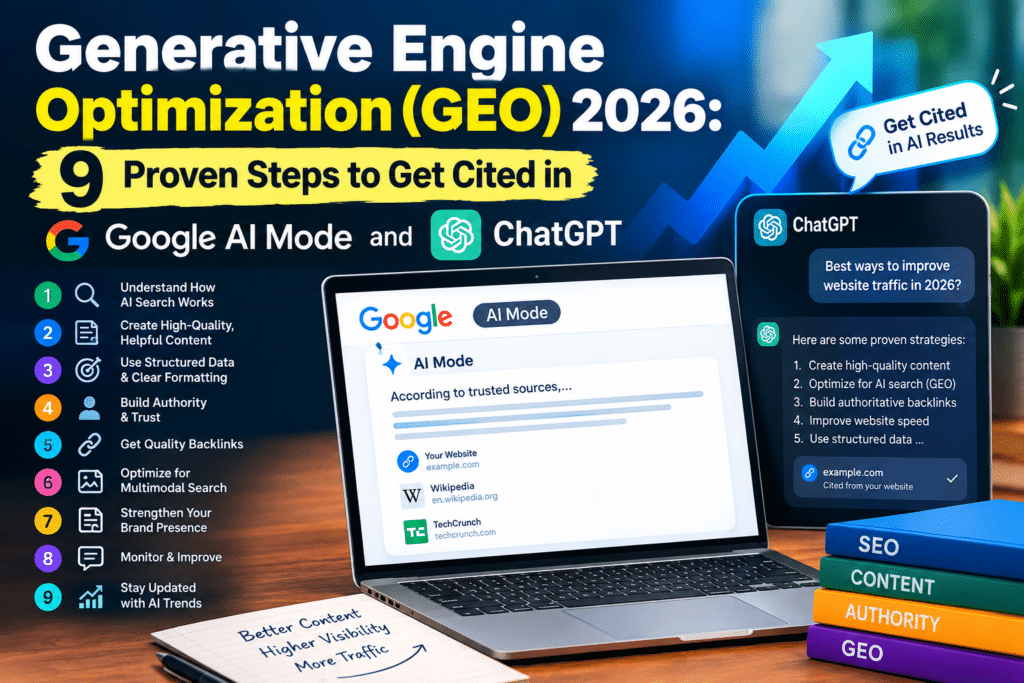
Table of Contents
- What Is Generative Engine Optimization (GEO)?
- Why GEO Is Trending Right Now (October 2026)
- GEO vs SEO: What Is the Difference?
- 9 Proven GEO Steps to Get Your Business Cited by AI
- How AI Search Engines Choose Which Sources to Cite
- Generative Engine Optimization Checklist
- Best Tools to Track GEO Results
- Example: GEO for a Local Business in Pakistan
- Common GEO Mistakes to Avoid
- GEO for Businesses in Pakistan: Why Start Now?
- Frequently Asked Questions
- Get Your Business Ready for AI Search
What Is Generative Engine Optimization (GEO)?
Generative Engine Optimization (GEO) is the practice of making your content easy for AI systems to find, understand, trust and quote. The goal is simple: when someone asks an AI tool a question about your industry, your brand should appear in the answer or be listed as a source.
You may also hear related terms such as AEO (Answer Engine Optimization), LLM optimization or AI SEO. They all describe the same shift: optimizing not only for rankings, but for inclusion in AI-generated answers.
Why GEO Is Trending Right Now (October 2026)
- AI Mode is mainstream. Google AI Mode now has more than a billion monthly users and has become Google’s main AI-powered search experience.
- Fewer clicks from classic results. When an AI Overview appears above the results, the top organic listings can receive far fewer clicks than before.
- Google is moving links higher in AI answers. In mid-October 2026, Google announced that inline source links will appear higher and more often inside AI Mode and AI Overviews. Being one of those sources is now a real traffic opportunity.
- Quality guidance was updated. On October 1, 2026, Google refreshed its guidance on AI-generated content, warning again against low-effort pages that add no original value.
- Ranking volatility. Many site owners reported traffic swings in October, and SEO experts expect another broad update aimed at thin, mass-produced content.
GEO vs SEO: What Is the Difference?
GEO does not replace SEO. Google itself says that optimizing for AI search experiences is still SEO, and its official AI features and your website guide confirms that the same SEO best practices apply to AI Overviews and AI Mode. The difference is in what you are aiming for:
| Factor | Traditional SEO | Generative Engine Optimization |
|---|---|---|
| Main goal | Rank in the top 10 links | Get cited or mentioned in AI answers |
| Success metric | Rankings, clicks, CTR | Citations, brand mentions, AI referral traffic |
| Content style | Keyword-focused pages | Clear, factual, quotable answers |
| Trust signals | Backlinks, on-page SEO | Backlinks plus brand mentions, reviews, community discussions |
| Platforms | Google, Bing | Google AI Mode, AI Overviews, ChatGPT, Gemini, Perplexity, Claude |
In short: strong SEO is the foundation, and GEO is the layer on top that helps AI tools pick you as a source.
9 Proven GEO Steps to Get Your Business Cited by AI
1. Answer the Question in the First Two Sentences
AI systems love content that gives a direct answer quickly. Start each section with a clear, one or two sentence answer, then add detail. For example, a page on website prices should open with an actual price range, not a long introduction.
2. Use Question-Based Headings
Write H2 and H3 headings the way people speak to AI tools: “How much does SEO cost in Pakistan?” or “Is WordPress better than Shopify for a small store?” Conversational questions match how users prompt AI Mode and ChatGPT.
3. Add Real Numbers, Prices and Original Data
Generic content is easy to replace. Specific facts are easy to quote. Share your own prices, timelines, case results and local market data. Original information is one of the strongest reasons for an AI engine to cite you instead of a competitor.
4. Structure Content With Tables, Lists and FAQs
Comparison tables, step lists and short FAQ sections are simple for AI models to extract. Schema markup such as Article and FAQ (added with a plugin like Rank Math) still helps search engines understand your page. Google says no special schema is required for AI features, but your structured data should always match the visible text.
5. Show Real Expertise (E-E-A-T)
Add author names, short bios, credentials and real project experience. Link to trusted sources when you cite statistics. Pages that look anonymous or mass-produced are less likely to be trusted by Google or AI systems.
6. Build Brand Mentions Beyond Your Website
AI models rarely rely on a brand’s own website alone. They also look at what others say about you. Get listed in trusted directories, earn reviews on Google Business Profile, take part in Reddit and Quora discussions, and get featured on industry blogs and local news sites.
7. Keep Your Technical SEO Clean
If search bots cannot crawl your pages, AI cannot use them. Make sure your site is fast, mobile-friendly and indexable, with a working XML sitemap and no important pages blocked in robots.txt. Also review which AI crawlers you allow, because blocking them can keep your content out of AI answers.
8. Update Content Regularly
AI search favors fresh, accurate information. Update prices, dates and statistics at least every few months, and show a visible “last updated” date. An outdated 2024 price list will not be quoted in a 2026 answer.
9. Track AI Visibility, Not Just Rankings
Check how your brand appears when you ask ChatGPT, Gemini and Google AI Mode about your services. Watch referral traffic from AI platforms in Google Analytics; Google has started adding tracking parameters to links from Gemini, which makes this easier. Google has also introduced generative AI performance reports in Search Console, and some SEO tools now measure AI visibility directly.
How AI Search Engines Choose Which Sources to Cite
To use Generative Engine Optimization well, it helps to understand how AI answers are built. When a user asks a question, the AI system looks for pages that are relevant, trustworthy and easy to extract facts from. It then combines information from several sources into one answer and adds links to some of them.
In Google AI Mode and AI Overviews, these sources still come from Google’s search index. That is why a page that is not indexed, or that ranks poorly, rarely gets cited. ChatGPT, Gemini and Perplexity also use web search behind the scenes, so the same basics apply across platforms.
In our experience, the pages that get cited most often share a few traits:
- They give a clear, direct answer near the top of the page
- They include specific numbers, prices, dates or examples
- They come from a brand that is mentioned on other trusted websites
- They are recently updated and technically easy to crawl
- They are written by someone who clearly knows the topic
Google’s own guide to optimizing for generative AI features also stresses valuable, unique, non-commodity content and busts several common AEO and GEO myths. If your page simply repeats what ten other sites already say, an AI model has no reason to choose you.
Generative Engine Optimization Checklist
Use this quick checklist before you publish or update any important page:
- The main question is answered in the first two sentences
- Headings are written as real questions people ask
- The page includes at least one table, list or step-by-step section
- Prices, numbers and dates are current and accurate
- Author name and expertise are visible
- Internal links point to related pages on your site
- Trusted external sources are linked where you cite facts
- The page is indexed, fast and mobile-friendly
- Your brand is listed on Google Business Profile and key directories
- A short FAQ section covers follow-up questions
Best Tools to Track GEO Results
Measuring Generative Engine Optimization is still new, but you can already track progress with a few tools:
- Google Search Console: traffic from AI Overviews and AI Mode is included in your Performance report, so watch impressions and clicks for your target questions.
- Google Analytics: check referral traffic from chatgpt.com, gemini.google.com and perplexity.ai to see how many visitors arrive from AI tools.
- Manual AI checks: once a month, ask ChatGPT, Gemini and Google AI Mode the questions your customers ask and note whether your brand appears.
- SEO plugins and platforms: tools such as Rank Math and other SEO suites now offer AI visibility tracking for brands and keywords.
Example: GEO for a Local Business in Pakistan
Imagine a dental clinic in Lahore. A typical website has a home page, a list of services and a contact form. When someone asks Google AI Mode “How much does teeth whitening cost in Lahore?”, that website has nothing useful to quote.
With Generative Engine Optimization, the clinic would publish a clear page titled “Teeth Whitening Cost in Lahore (2026)”. The first lines would give the actual price range, followed by a table comparing treatment types, a short section on how long results last, the dentist’s qualifications, and an FAQ. The clinic would also collect Google reviews and get listed on health directories.
Now the AI system has a specific, trusted, local answer to cite. The same approach works for real estate agents, online stores, software houses and service providers in any city.
Common GEO Mistakes to Avoid
- Publishing hundreds of thin AI-written articles with no original value
- Stuffing keywords instead of answering the real question
- Hiding prices and key details behind a contact form
- Ignoring reviews, directories and off-site brand mentions
- Blocking important pages or crawlers by mistake
GEO for Businesses in Pakistan: Why Start Now?
Most Pakistani businesses are still focused only on classic rankings, and very few are optimizing for AI answers yet. That means the competition for AI citations in local markets is still low. A Lahore clinic, a Karachi online store or a Multan real estate agency that structures its content well today can become the default answer AI tools give tomorrow.
If you are just getting started, read our guide on SEO for small business first, because GEO works best on top of a solid SEO foundation.
Frequently Asked Questions
Is GEO replacing SEO?
No. GEO builds on SEO. Good rankings, clean technical setup and quality content are still the base that AI search engines use to choose their sources.
How long does GEO take to show results?
It depends on your site’s authority and competition. Content changes can be picked up within weeks, but building the brand mentions and trust that AI tools rely on usually takes a few months of steady work.
Can a small business compete in AI search?
Yes. AI tools often cite specific, helpful pages from smaller sites, especially for local and niche questions. Clear answers and real expertise matter more than company size.
Which AI platforms should I optimize for?
Start with Google AI Mode and AI Overviews because of their reach, then check ChatGPT, Gemini and Perplexity. The same core practices help across all of them.
What is the difference between GEO and AEO?
The terms overlap. AEO (Answer Engine Optimization) focuses on giving direct answers that search features can show, while Generative Engine Optimization focuses on being cited inside AI-generated responses. In practice, the same content habits help with both.
Do I need special schema for GEO?
No special schema is required. Standard structured data like Article and FAQ is still useful, as long as it matches the content visible on the page.
Get Your Business Ready for AI Search
The businesses that win in AI search over the next few years will not be the ones publishing the most content. They will be the ones publishing the clearest, most useful and most trusted answers. Generative Engine Optimization is simply the discipline of doing that on purpose. Start with your five most important service pages, apply the checklist above, and measure the results month by month. Small, consistent Generative Engine Optimization improvements add up quickly.
AI search is already deciding which brands customers see first. NovaXperts helps businesses in Pakistan and abroad with SEO and Generative Engine Optimization, from content structure and schema to brand mentions and AI visibility tracking. Contact us today or call +92-307-1008770 for a free consultation.
