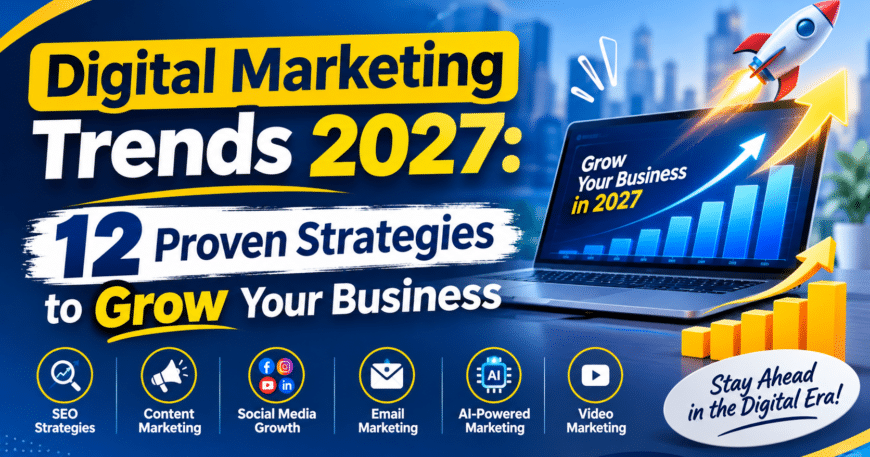
Marketing in 2027 will look very different from even two years ago. AI now writes ads, chooses audiences and answers customer questions. Search engines answer queries without sending clicks. Social platforms have become search engines of their own. For business owners and marketers, the question is simple: where should you put your time and budget next year?
In this guide we break down the digital marketing trends 2027 will be shaped by, using real 2026 data and platform announcements rather than hype. For each trend we explain what is changing and exactly what to do about it, whether you run a local shop, an online store, a B2B company or an agency.
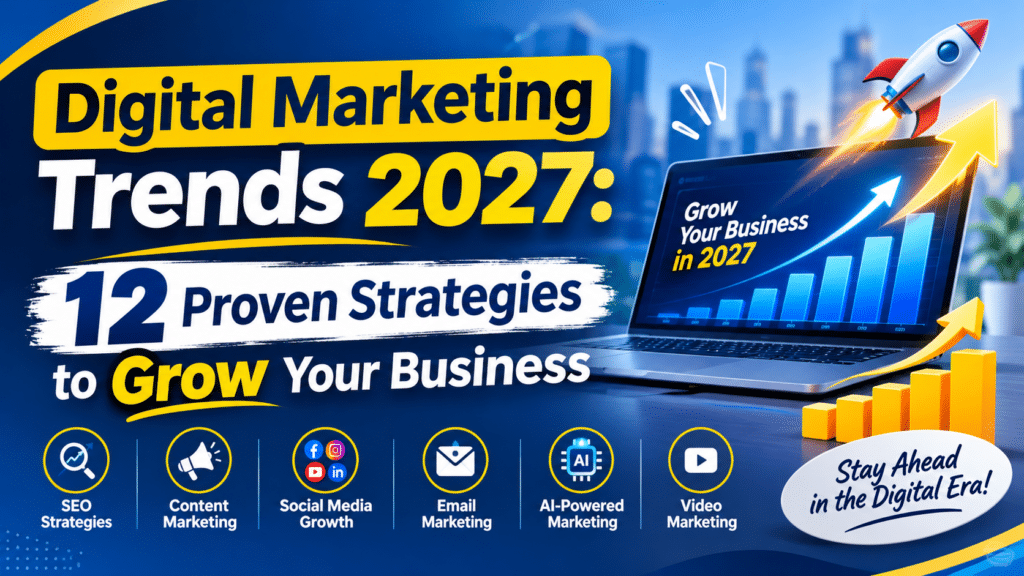
Table of Contents
Why Digital Marketing in 2027 Will Feel Different
Three big shifts are already underway, and they will define digital marketing in 2027:
- AI is answering questions before people click. Google says AI Overviews reach more than 2.5 billion monthly users, and OpenAI reported that ChatGPT has more than 900 million weekly active users.
- Ad platforms are automating almost everything. Google will automatically upgrade Dynamic Search Ads campaigns to AI Max starting in February 2027, and Meta has been moving towards ads that are created and targeted almost entirely by AI.
- Clicks are getting harder to win. A SparkToro study found that 68.01% of Google searches ended without a click in the first four months of 2026.
The trends below are predictions, but each one is built on changes that are already happening. Businesses that prepare in late 2026 will be far ahead when 2027 arrives.
Digital Marketing Trends 2027 at a Glance
Short on time? Here is a quick summary of the digital marketing trends 2027 will be built on and the first action to take for each:
| Trend | What is changing | First action |
|---|---|---|
| AI search | Customers research with AI assistants and AI Overviews | Answer customer questions clearly on your website |
| Automated ads | Google AI Max and Meta Advantage+ handle targeting | Fix conversion tracking and set clear guardrails |
| Creative-led performance | Creative decides who sees your ads | Test new ad creatives every month |
| First-party data | Tracking is harder across browsers and apps | Grow your email and WhatsApp lists |
| Video and social search | People search on TikTok, Instagram and YouTube | Publish short, helpful videos |
| Creators | Micro-creators become a normal channel | Run one small creator test |
| Smarter measurement | Last-click data tells an incomplete story | Track revenue against total spend |
1. AI Search Becomes a Core Marketing Channel
Customers increasingly research products and services through AI search and AI assistants instead of typing short keywords. They ask full questions, compare options and often decide which brands to contact before they ever visit a website.
What to do: treat AI visibility as part of your marketing plan. Make sure your website clearly explains what you sell, who it is for, where you operate and what it costs. Publish helpful guides that answer real customer questions, and earn mentions on trusted websites. Our guide to Generative Engine Optimization (GEO) explains how to start.
2. Brand Building Matters More Than Ever
When fewer searches lead to clicks, the brands that win are the ones people already know and search for by name. In 2027, strong brands will get recommended more often by AI tools, clicked more often in search results and trusted faster by new customers.
What to do: invest in being memorable, not just visible. Use a consistent name, logo, colours and message everywhere. Create content that shows your personality and expertise, and track branded search volume as a key marketing metric.
3. AI-Powered Advertising Becomes the Default
Google and Meta are both pushing advertisers towards automated campaigns. Google’s AI Max for Search left beta in April 2026, and Dynamic Search Ads will be upgraded to it automatically from February 2027. On Meta, Advantage+ campaigns already handle targeting, placements and budget decisions, and the company has openly aimed to automate ad creation and targeting with AI.
What to do: learn to guide the machines instead of fighting them. Give the platforms clean conversion data, clear goals and strong landing pages. Set brand guidelines, exclusions and budget limits, and test automated campaigns against your current setup before switching everything over.
4. Creative Becomes the Main Lever in Paid Ads
When AI handles targeting, the biggest difference between a winning and a losing campaign is the creative itself. Platforms now use your images, videos and copy to decide who sees your ads, so a wider range of strong creatives gives the algorithm more to work with.
What to do: produce more creative variations, not more audience segments. Test different hooks, formats, offers and angles every month. Short vertical videos, customer testimonials and simple product demos usually perform well. If you advertise on Facebook and Instagram, broad audiences with strong creative often beat narrow interest targeting.
5. First-Party Data Is Your Biggest Asset
Google decided in 2025 to keep third-party cookies in Chrome, but that does not mean tracking is easy. Safari, Firefox and Brave already block third-party cookies by default, privacy rules keep tightening and many users decline tracking. The businesses that own their customer data will market more effectively and more cheaply in 2027.
What to do: build your own data. Grow an email list and a WhatsApp broadcast list, use a simple CRM, offer genuine value in exchange for sign-ups, and set up server-side tracking such as the Meta Conversions API and enhanced conversions in Google Ads. Always ask for consent and explain how you use data.
6. Short-Form Video and Social Search Keep Growing
Short vertical video remains the most engaging format on social media, and many younger users now search for products, places and how-to answers directly on TikTok, Instagram and YouTube. In 2027, social content will need to be discoverable through search, not just through followers.
What to do: create short, helpful videos that answer common customer questions. Use clear spoken keywords, on-screen text and descriptive captions so platforms understand what the video is about. Repurpose each video across Reels, Shorts and TikTok, and embed the best ones on your website.
7. Creator and Influencer Marketing Goes Mainstream
Influencer marketing is no longer an experiment. Influencer Marketing Hub estimated the global industry at US$32.55 billion in 2025, and in its 2026 benchmark report 87.49% of brands expected their influencer budgets to increase. In 2027, smaller creators with loyal, niche audiences will become a normal part of many small business marketing plans.
What to do: start small and local. Work with micro-creators whose audience matches your customers, give them freedom to present your product in their own style, and track results with unique discount codes or links. Long-term partnerships usually outperform one-off posts.
8. Conversational Marketing and AI Assistants
Customers expect fast answers at any time of day. In 2027, more businesses will use AI chat assistants on websites and messaging apps to answer questions, qualify leads and book appointments, while human teams handle complex conversations and closing.
What to do: map the questions customers ask most often and make sure they are answered on your website, in your chat tools and on WhatsApp. If you add an AI assistant, train it on accurate information, make it easy to reach a human and review conversations regularly.
9. Personalisation at Scale
AI makes it possible to tailor emails, offers, product recommendations and website content to different customer groups without a huge team. In 2027, generic one-size-fits-all messaging will feel increasingly outdated.
What to do: start with simple segments such as new customers, repeat buyers and inactive customers, and send each group a relevant message. Use purchase history and website behaviour to recommend products, and personalise based on data customers have shared with you willingly.
10. Authenticity and Human-Made Content Stand Out
As AI-generated content floods every channel, real people, real stories and real proof become more valuable. Customers increasingly trust content that shows the team behind a business, genuine customer results and honest opinions.
What to do: show your people and your process. Share behind-the-scenes content, founder stories, case studies with real numbers and genuine customer reviews. Use AI to speed up production, but keep human judgement, experience and personality at the centre of your content.
11. Local and Map-Based Marketing Grows
Local searches are increasingly answered by AI with short lists of recommended businesses, built from Google Business Profile data, reviews and consistent local information. For local businesses, this can be one of the cheapest growth channels in 2027.
What to do: keep your Google Business Profile complete and active, collect genuine reviews, post updates regularly and create clear location pages on your website. Our guide to SEO for small business covers the essentials.
12. Smarter Measurement Beyond Last-Click
With fewer clicks, more privacy controls and more automated campaigns, last-click attribution tells an incomplete story. In 2027, smart marketers will judge performance using a mix of signals rather than one dashboard number.
What to do: track total revenue against total marketing spend, cost per customer across all channels, branded search growth, and leads from every source. Ask new customers how they found you, run simple tests such as pausing a channel in one region, and review results monthly instead of daily.
How AI Will Change Everyday Marketing Work in 2027
Beyond individual channels, AI will change how marketing teams work day to day. Digital marketing in 2027 will reward teams that use AI for speed while keeping humans in charge of strategy and quality:
- Research: AI search tools summarise competitors, customer questions and market trends in minutes instead of days.
- Content production: first drafts of blog posts, ad copy, product descriptions and video scripts can be produced quickly, then edited and fact-checked by people.
- Creative testing: image and video tools make it easy to create many ad variations for testing.
- Customer service: AI assistants answer common questions around the clock and pass complex cases to staff.
- Reporting: dashboards and AI summaries highlight what changed and why, so teams spend more time acting on insights.
The risk is publishing AI output without review. Inaccurate facts, generic messaging and off-brand content can damage trust quickly, so build a simple review step into every workflow.
What Will Stop Working in 2027
- Mass-produced AI content that adds nothing new and damages trust.
- Over-segmented ad accounts with tiny audiences that starve automated campaigns of data.
- Relying only on rented platforms without building an email list or customer database.
- Boosting random posts instead of running planned campaigns with clear goals.
- Judging success by likes and followers rather than leads, sales and customer value.
How to Plan Your 2027 Marketing Budget
Every business is different, but this framework can help you divide your budget across goals. Treat it as a starting point, not a rule:
| Area | What it covers | Why it matters in 2027 |
|---|---|---|
| Foundation | Fast website, tracking, Google Business Profile, CRM | Every other channel performs better on a strong foundation |
| Demand capture | Google Ads, SEO, local search | Reaches people who are already looking for what you sell |
| Demand creation | Meta and TikTok ads, video, creators | Builds awareness and fills the funnel with new prospects |
| Retention | Email, WhatsApp, loyalty offers | Cheapest growth comes from customers you already have |
| Testing | New platforms, formats and AI tools | Keeps you ahead as channels change |
If your website is slow or outdated, fix it before you increase ad spend. Our guide to website development cost in Pakistan explains typical budgets.
Digital Marketing Trends 2027 by Business Type
Local businesses
Focus on Google Business Profile, reviews, local SEO, WhatsApp communication and short videos that show your team and work. Small local creator partnerships can also work well.
Ecommerce stores
Prioritise strong product creative, automated shopping campaigns with clean conversion data, email and SMS retention flows, and short-form video. If you are starting out, read how to start an online store in Pakistan and compare WordPress vs Shopify.
B2B and service companies
Invest in expert content, case studies, LinkedIn thought leadership, original research and clear pricing pages, because business buyers increasingly research with AI tools before contacting a supplier.
Marketing agencies
Upskill your team in AI-driven campaigns, creative production and measurement, and help clients understand new metrics such as AI search visibility and branded search.
A 90-Day Plan to Prepare for 2027
| Period | Focus | Key actions |
|---|---|---|
| Days 1 to 30 | Foundation | Audit your website speed, tracking, Google Business Profile and CRM, and fix the biggest gaps |
| Days 31 to 60 | Content and creative | Build a library of short videos, customer stories and helpful guides, and test new ad creatives |
| Days 61 to 90 | Data and automation | Grow your email and WhatsApp lists, test automated ad campaigns and set up monthly reporting |
Repeat the cycle every quarter. Steady improvements will compound throughout 2027.
Your Digital Marketing Checklist for 2027
- Make your website fast, clear and easy to understand for people and AI tools
- Set up accurate conversion tracking, including server-side tracking where possible
- Keep your Google Business Profile complete and collect genuine reviews
- Produce new ad creatives and short videos every month
- Build and use your own email and WhatsApp lists
- Test automated campaigns on Google and Meta with clear guardrails
- Partner with a few relevant micro-creators
- Show real people, real results and real expertise in your content
- Track revenue, cost per customer and branded search, not just clicks
Frequently Asked Questions
What are the biggest digital marketing trends for 2027?
The biggest trends are the rise of AI search, automated advertising on Google and Meta, the growing importance of creative and first-party data, short-form video and social search, creator marketing and smarter measurement beyond last-click attribution.
Will AI replace digital marketers in 2027?
No. AI will automate many repetitive tasks, but businesses still need people to set strategy, understand customers, produce strong creative, protect the brand and interpret results. The marketers who learn to guide AI tools will be in the highest demand.
Is SEO still important in 2027?
Yes. Search engines and AI assistants still rely on websites for information. SEO is expanding to include visibility in AI answers, while technical health, helpful content and authority remain essential.
Which social media platform is best for business in 2027?
It depends on your audience. Instagram and Facebook remain strong for most consumer businesses, TikTok and YouTube Shorts are powerful for reaching younger audiences, and LinkedIn is best for B2B. Focus on the platforms your customers actually use.
How much should a small business spend on digital marketing in 2027?
There is no single right number. Start with a budget you can sustain for at least three to six months, invest first in your website and tracking, then add channels based on results.
When should I start preparing for digital marketing trends 2027?
Now. Building content, data and creative libraries takes time, so the work you do at the end of 2026 will deliver results throughout 2027.
Final Thoughts
The digital marketing trends 2027 will bring all point in the same direction: AI will handle more of the mechanics, so your advantage will come from strong creative, real expertise, owned customer data and a brand people trust. Start with the checklist above, fix your foundation and test new approaches every quarter.
If you want a team that handles websites, SEO, paid ads and social media together, NovaXperts can help you prepare for 2027. Explore our services or contact our team to discuss your goals.