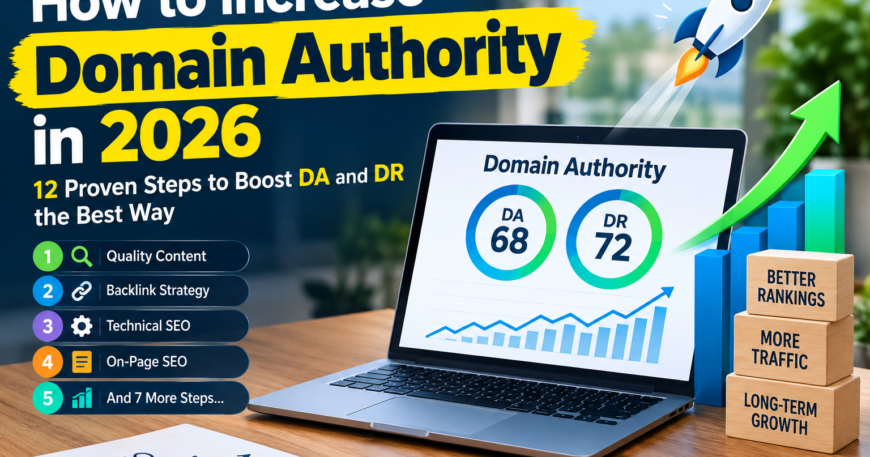
“What is our DA, and how do we make it higher?” is one of the first questions business owners ask us when they start investing in SEO. A strong authority score makes it easier to rank for competitive keywords, attract partners and win guest post opportunities. The problem is that most advice online is either outdated or pushes risky shortcuts.
In this guide we explain exactly how to increase domain authority the safe way in 2026. You will learn what DA and DR really measure, why Google does not use them directly, and 12 proven steps our team uses to increase domain authority for clients in Pakistan and abroad, without buying spammy links.
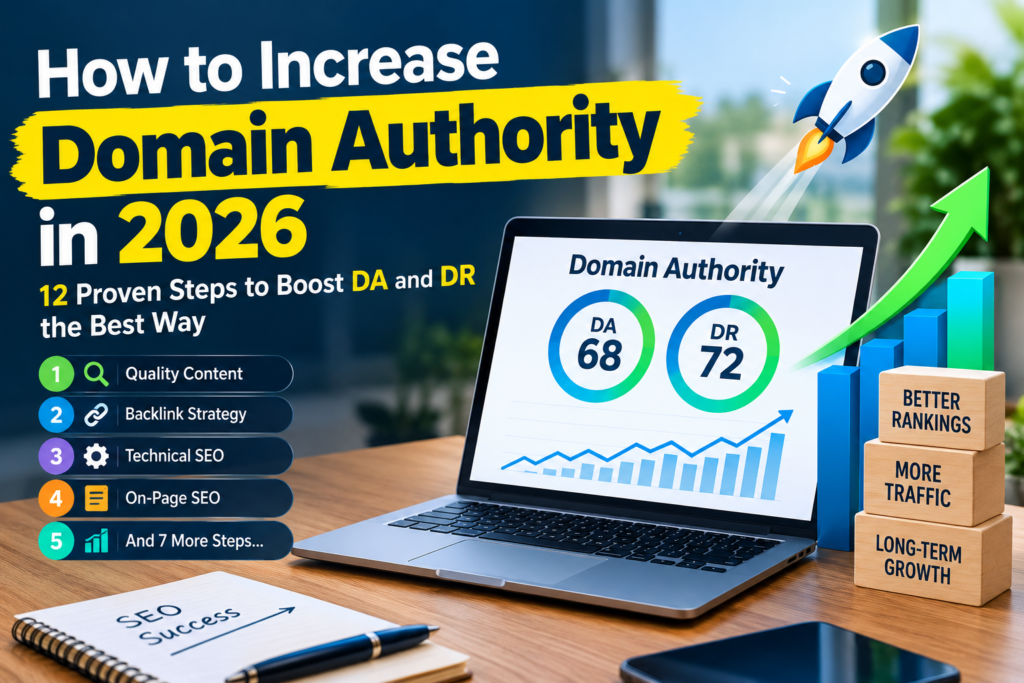
Table of Contents
What Is Domain Authority (DA)?
Domain Authority is a score from 1 to 100 created by the SEO software company Moz. It predicts how likely a website is to rank in search results compared with other sites. The score is based mainly on your backlink profile: how many different websites link to you, how trustworthy those websites are, and whether your link profile looks natural or manipulated.
Two details matter before you try to increase domain authority:
- The scale is logarithmic. Moving from DA 10 to 20 is much easier than moving from 60 to 70.
- It is relative. Your score is compared with every site in the Moz index, so it can move up or down when Moz refreshes its data, even if nothing changed on your site.
DA vs DR vs Authority Score
Different SEO tools have their own authority metric. They work in a similar way, but the numbers are not interchangeable:
| Metric | Tool | Scale | Main inputs |
|---|---|---|---|
| Domain Authority (DA) | Moz | 1 to 100 | Linking root domains, link quality, spam signals |
| Domain Rating (DR) | Ahrefs | 0 to 100 | Unique referring domains with followed links, and how strong those domains are |
| Authority Score (AS) | Semrush | 0 to 100 | Link power, organic traffic and spam signals |
According to Ahrefs, a referring domain passes more strength when it links to only a few other sites, so one link from a focused, relevant blog can be worth more than a link from a huge directory. The good news: the same work will increase domain authority, DR and Authority Score together.
Is Domain Authority a Google Ranking Factor?
No. Google has repeatedly said it does not use Moz’s Domain Authority, or any similar third-party score, for crawling, indexing or ranking. You can read the full background in Search Engine Journal’s analysis.
So why do SEO professionals still try to increase domain authority? Because DA is a useful proxy. It reflects the quality and number of backlinks you earn, and backlinks are still one of the strongest signals in Google’s algorithm. When you increase domain authority the right way, you are really building the kind of link profile and trust that helps your rankings.
What Is a Good Domain Authority Score?
There is no universal “good” number. A local bakery in Multan does not need the same score as a national news site. The smart way is to compare yourself with the websites that rank on page one for your main keywords.
| DA / DR range | What it usually means |
|---|---|
| 1 to 20 | New or small website with few backlinks |
| 20 to 40 | Growing site with a solid base; competitive in local and niche markets |
| 40 to 60 | Strong authority; can compete for many national keywords |
| 60+ | Very strong; typical of large brands, publishers and big platforms |
If your competitors sit around DA 25 and you are at 12, your goal is to close that gap. That is a realistic target, and it is exactly what our 12 steps below are designed for.
How to Increase Domain Authority: 12 Proven Steps
There is no secret trick. To increase domain authority you need to earn links from many different, relevant and trusted websites, while keeping your site technically healthy. Here is the process we follow.
1. Audit Your Current Backlink Profile
Start by checking your score and your referring domains in Moz Link Explorer and the free Ahrefs backlink checker. Note how many unique domains link to you, which pages attract links and where your competitors get their links from. This audit shows the fastest opportunities to increase domain authority.
2. Fix Technical SEO Issues
Links help most when search engines can crawl and understand your site easily. Fix broken pages, redirect chains, slow loading, missing HTTPS and mobile issues. Make sure your important pages are indexed and your XML sitemap is clean. A technically healthy site also keeps visitors longer, which makes other sites more willing to link to you.
3. Create Linkable Assets
People link to content that is useful, unique or easy to cite. Good linkable assets include original surveys and data, price guides, free tools and calculators, templates, checklists and in-depth guides. For example, our website development cost in Pakistan guide answers a question many bloggers and journalists write about, which makes it a natural source to link to.
4. Strengthen Internal Linking
Internal links do not change DA directly, but they spread the strength of your best pages across your site and help new pages rank faster. Link from high-traffic posts to your service pages and related articles using clear, descriptive anchor text.
5. Guest Post on Relevant, Real Websites
Writing helpful articles for respected blogs in your industry is still one of the most reliable ways to increase domain authority. Focus on sites with real organic traffic and an audience similar to yours, not “write for us” sites that publish anything for money.
6. Use Digital PR and Expert Quotes
Journalists and bloggers constantly look for expert opinions. Platforms that connect experts with reporters, plus your own press outreach, can earn links from news sites that are almost impossible to get any other way. A few high-authority mentions can increase domain authority more than dozens of small directory links.
7. Try Broken Link Building
Find pages in your niche that link to content that no longer exists. Create a better resource on the same topic, then politely suggest your page as a replacement to the site owner. You solve their problem and earn a relevant link at the same time.
8. Turn Brand Mentions into Links
As your business grows, people will mention your brand without linking to you. Set up alerts for your company name, then contact the authors and ask if they can add a link. These are some of the easiest links to win because the writer already knows and trusts your brand.
9. Build Local Citations and Business Profiles
List your business on trusted directories, industry associations, chambers of commerce and platforms like Google Business Profile. Many of these links are nofollow, but they build trust, support local SEO and often lead to real referral traffic. Read our SEO for small business guide for local SEO tips that work well with this step.
10. Clean Up Toxic Links
A sudden wave of spammy links can lower your Moz Spam Score and make your profile look manipulated. Review new links regularly. Ask site owners to remove obviously harmful links, and use Google’s disavow tool only for clearly toxic links, because aggressive disavowing can hurt more than it helps.
11. Build Relationships and Partnerships
Suppliers, partners, clients, software vendors and local organisations are natural link sources. Offer testimonials for tools you use, sponsor community events, co-create content with partners and join podcasts or webinars. Relationship-based links are stable, relevant and hard for competitors to copy.
12. Publish Consistently and Track Progress
Authority grows with consistency. Publish helpful content every month, keep promoting your best pieces and track referring domains, DA, DR, rankings and organic traffic monthly. Remember that metrics update on their own schedules, so judge progress over quarters, not days.
One more tip: save every link you earn in a simple spreadsheet with the date, linking site, target page and anchor text. This record helps you spot lost links early, see which tactics work best and report progress clearly to your team or clients.
Domain Authority vs Page Authority
Moz also has a second score called Page Authority (PA). Domain Authority measures the strength of your whole website, while Page Authority measures the strength of one specific page. A blog post with many good backlinks can have a high PA even on a young domain.
This matters for your strategy. When you try to increase domain authority, you are really building strong individual pages that attract links and then sharing that strength across the site through internal links. Both scores rise together when you earn links to several different pages instead of only your homepage.
On-Page SEO That Supports Your Authority
Backlinks drive authority scores, but your on-page SEO decides whether that authority turns into rankings. Before you spend money on outreach, make sure every important page has:
- A clear focus keyword and a title tag that matches search intent
- Helpful, original content that answers the question better than competitors
- Descriptive headings, short paragraphs and relevant images with alt text
- Schema markup where it fits, such as FAQ, article or local business
- Fast loading speed and a clean mobile layout
- Clear author information and real contact details to build trust
A site that is easy to read and genuinely useful earns links naturally over time, which is the most sustainable way to increase domain authority.
A 90-Day Plan to Increase Domain Authority
If you are not sure where to begin, follow this simple three-month roadmap. It is the same structure we use when we onboard a new SEO client at NovaXperts.
| Period | Main focus | Key tasks |
|---|---|---|
| Days 1 to 30 | Foundation | Backlink and technical audit, fix site errors, set up tracking, list competitor link sources |
| Days 31 to 60 | Content and assets | Publish two or three linkable assets, improve internal linking, claim business profiles and citations |
| Days 61 to 90 | Outreach | Guest posts, broken link building, brand mention outreach, partner and supplier links |
After 90 days, repeat the cycle with new content and new outreach targets. Small, consistent wins every month are what increase domain authority over the long term.
Outreach Tips That Get Replies
Most link building fails because outreach emails look like spam. To increase domain authority with outreach, keep these rules in mind:
- Personalise every email. Mention a specific article on their site and why your resource fits.
- Lead with value. Offer a fix, an update, data or a better resource, not just a request for a link.
- Keep it short. Four or five sentences are enough.
- Follow up once. A polite reminder after a week often doubles responses; more than that feels pushy.
Should You Buy Backlinks?
Buying links that pass ranking value goes against Google’s spam policies. Paid placements are acceptable only when they are clearly marked with a sponsored or nofollow attribute, and those links do not pass authority. Cheap packages that promise to increase domain authority overnight usually rely on link networks that Google can detect and ignore, so you lose money and may damage trust in your site.
Instead of buying links, invest the same budget in content, digital PR and outreach. These channels build real relationships and real referral traffic, and their value keeps growing for years.
How Long Does It Take to Increase Domain Authority?
For most websites, it takes several months of steady work to increase domain authority in a meaningful way, and often six to twelve months to see a big change. New sites usually move faster at the start because the scale is easier at the low end. After DA 40, every extra point needs significantly more strong links.
Be careful with anyone who promises to increase domain authority by 20 or 30 points in a few weeks. Fast jumps usually come from manipulative links that are easy for search engines to ignore or penalise.
Mistakes to Avoid When You Increase Domain Authority
- Buying cheap “DA 50+” link packages. They usually come from private blog networks or link farms that add risk and no real value.
- Chasing the number instead of traffic. A higher score means nothing if rankings and leads do not improve.
- Using exact-match anchor text everywhere. Natural profiles use brand names, URLs and varied phrases.
- Getting many links from one domain. Ten links from one site still count as one referring domain for authority metrics.
- Ignoring relevance. A link from an unrelated site in another language rarely helps.
- Stopping after a few months. Links can be lost over time, so authority needs ongoing work.
Best Tools to Check and Track Domain Authority
| Tool | What it shows | Free option |
|---|---|---|
| Moz Link Explorer | Domain Authority, linking root domains, Spam Score | Limited free checks |
| Ahrefs | Domain Rating, referring domains, lost and new links | Free backlink and DR checker |
| Semrush | Authority Score, backlink gap with competitors | Limited free account |
| Google Search Console | Top linking sites and pages Google knows about | Completely free |
We recommend using Google Search Console together with one paid tool. Search Console shows the links Google actually sees, while the paid tool helps you find new opportunities to increase domain authority faster than your competitors.
Need Help to Increase Domain Authority?
Building authority takes time, outreach skills and a clear strategy. At NovaXperts, our SEO team combines technical SEO, content creation and white-hat link building to increase domain authority and, more importantly, grow real organic traffic and leads. Our founder Shahzad Riaz personally oversees every off-page SEO campaign.
Explore our SEO and web development services or contact us for a free backlink audit and a realistic plan for your website.
Frequently Asked Questions
Can I increase domain authority quickly?
You can see small gains in a few months, especially on a new site, but there is no safe way to increase domain authority overnight. Quick jumps usually come from low-quality links that do not help rankings.
Does social media increase domain authority?
Not directly, because most social links are nofollow. However, sharing your content on social media helps the right people discover it, and some of them will link to it from their own websites.
Why did my domain authority drop?
DA can drop when you lose backlinks, when Moz updates its index, or when other sites grow faster than yours. Because the score is relative, a small drop is normal and not a reason to panic if your traffic is stable.
Is DR more important than DA?
Neither is used by Google. DR (Ahrefs) and DA (Moz) are both useful benchmarks. Pick one main tool, track it consistently and focus on the links and traffic behind the number.
How many backlinks do I need to increase domain authority?
There is no fixed number. What matters is the number of different, trusted and relevant websites linking to you. Ten good links from ten real sites will do more than a hundred links from one weak directory.
Final Thoughts
If you want to increase domain authority in 2026, forget shortcuts and focus on fundamentals: a technically healthy site, content people want to reference, and steady, relationship-based link building. These are the same signals that help you rank on Google, which is the real goal behind every authority score.
Start with a backlink audit, pick three or four of the steps above and work on them every month. Track your progress, stay patient and you will see your authority, rankings and organic traffic rise together. And if you would like an expert team to handle it for you, NovaXperts is ready to help.